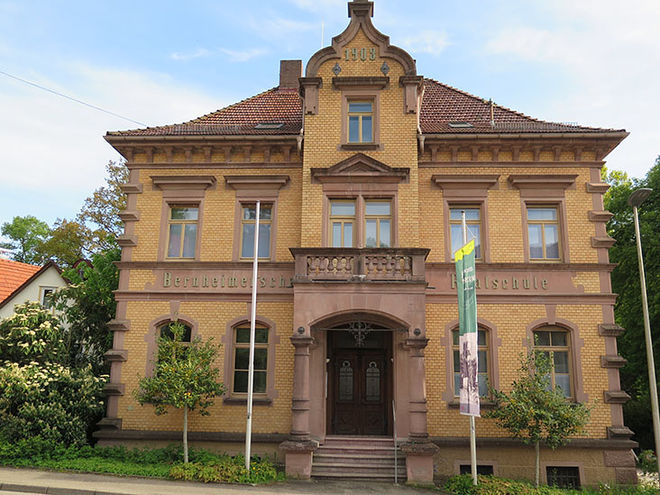
The former Realschule in Buttenhausen, Germany, now housing the Jewish Museum of Buttenhausen. Photo by Gabrielle A. Berlinger.
Join us this fall for the Leon Levy Foundation Lectures in Jewish Material Culture. Gabrielle A. Berlinger (University of North Carolina) will deliver a three-part lecture series entitled “The Buildings that Remain: Finding Purpose in Place through Collective Preservation.”
October 16, Lecture 1: 770: A Constellation of Sacred Sites
November 13, Lecture 2: Elsewhere: Archive, Museum, and Catalyst of Change
December 11, Lecture 3: Buttenhausen: The Material Afterlife of a German Jewish Community
The Buildings that Remain: Finding Purpose in Place through Collective Preservation
This series explores how three ordinary buildings have been transformed into extraordinary spaces for religious, social, and historic Jewish purpose: a medical clinic in Brooklyn, New York, a second-hand store in Greensboro, North Carolina, and a schoolhouse in southern Germany. Although geographically, temporally, and culturally distinct from one another, all three sites engage with Jewish memory, values, and practice through creative approaches to the preservation of these buildings and their material contents. Using strategies of reconstruction, restoration, and even deconstruction of these buildings and the objects within, the people who steward these sites nurture deep and dynamic relationships between people, objects, and a sense of belonging in each environment.
Lecture 3: Buttenhausen: The Material Afterlife of a German Jewish Community
This talk explores the Jewish material afterlife of Buttenhausen, a small rural village in southwest Germany. This village was home to Jews from 1787 until 1942, when Gabrielle Berlinger’s great-grandfather was the last Jewish resident deported. Today, no Jews live in Buttenhausen, but the work of several Christian residents has led to the establishment of a small Jewish museum, as well as the memorialization of Buttenhausen’s former Jewish residents through plaques on the outer walls of houses and imbedded in sidewalks, all stops on a self-guided historical walking tour. This presentation explores the buildings and material objects, both in the village and beyond, that continue to evoke the memory of Jewish life in this village.
Bard Graduate Center is grateful for the generous support of the Leon Levy Foundation.
Gabrielle A. Berlinger is associate professor of American studies and folklore and Babette S. and Bernard J. Tanenbaum Scholar in Jewish History and Culture at the University of North Carolina at Chapel Hill (UNC). As a folklorist and ethnologist, she studies the nature and significance of vernacular architecture and ritual practice, particularly in contemporary Jewish communities. Her article, “From Ritual to Protest: Sukkot in the Garden of Hope” in Buildings & Landscapes: Journal of the Vernacular Architecture Forum (University of Minnesota Press, 2017), received the 2019 Catherine Bishir Prize from the Vernacular Architecture Forum and is drawn from fieldwork for her book, Framing Sukkot: Tradition and Transformation in Jewish Vernacular Architecture (Indiana University Press, 2017). She is also coeditor of The Lives of Jewish Things: Collecting and Curating Material Culture (Wayne State University Press, 2024). Before joining the faculty at UNC, Gabrielle was an Andrew W. Mellon Postdoctoral Fellow in the “Cultures of Conservation” initiative at Bard Graduate Center in New York City. There, her research and teaching centered on an ethnographic project at the Lower East Side Tenement Museum in which she documented the preservation process of the museum’s nineteenth-century tenement apartment building—a study that related issues of historic preservation, immigrant social history, heritage management, and museum practice in the reconciliation of physical and cultural conservation needs.