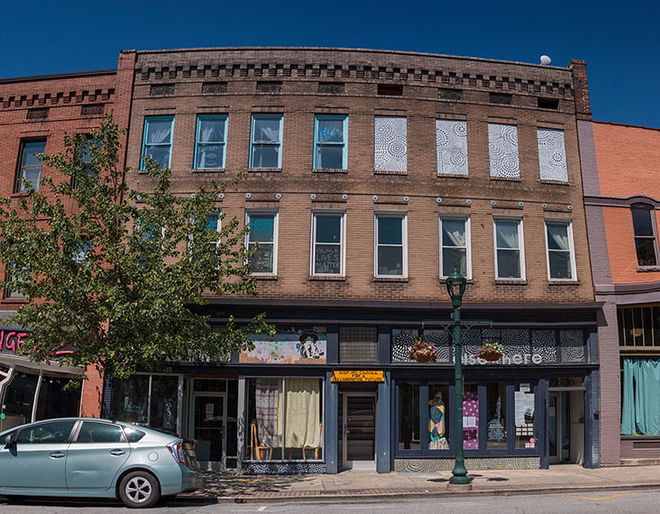
606 South Elm Street, Greensboro, North Carolina, home to Elsewhere: A Living Museum and Artist Residency. Photo courtesy Elsewhere.
Join us this fall for the Leon Levy Foundation Lectures in Jewish Material Culture. Gabrielle A. Berlinger (University of North Carolina) will deliver a three-part lecture series entitled “The Buildings that Remain: Finding Purpose in Place through Collective Preservation.”
October 16, Lecture 1: 770: A Constellation of Sacred Sites
November 13, Lecture 2: Elsewhere: Archive, Museum, and Catalyst of Change
December 11, Lecture 3: Buttenhausen: The Material Afterlife of a German Jewish Community
The Buildings that Remain: Finding Purpose in Place through Collective Preservation
This series explores how three ordinary buildings have been transformed into extraordinary spaces for religious, social, and historic Jewish purpose: a medical clinic in Brooklyn, New York, a second-hand store in Greensboro, North Carolina, and a schoolhouse in southern Germany. Although geographically, temporally, and culturally distinct from one another, all three sites engage with Jewish memory, values, and practice through creative approaches to the preservation of these buildings and their material contents. Using strategies of reconstruction, restoration, and even deconstruction of these buildings and the objects within, the people who steward these sites nurture deep and dynamic relationships between people, objects, and a sense of belonging in each environment.
Lecture 2: Elsewhere: Archive, Museum, and Catalyst of Change
Since 2005, the building at 606 South Elm Street in downtown Greensboro, North Carolina, has been known as Elsewhere—a living museum and artist residency. However, from 1955–97, this three-story building was a second-hand store owned and run by Sylvia Gray, a Southern Jewish woman who filled the building with American material goods, from buttons and dishes to toys, ribbon, clothes, books, and more. Six years after she passed away in 1997, her grandson, George Scheer, opened the building’s locked doors, found all of its contents untouched, and decided to transform Sylvia’s material “collection” into an experimental museum and art space. By examining Elsewhere’s annual “Radical Seder” that weaves the building’s story and preservation philosophy into the ancient Passover ritual, as well as other instances of Jewish expression that intersect with Elsewhere’s material collection, Gabrielle Berlinger—in conversation with Scheer—considers how Elsewhere’s material world and creative preservation are informed by and reanimate Jewish values.
Bard Graduate Center is grateful for the generous support of the Leon Levy Foundation.
Gabrielle A. Berlinger is associate professor of American studies and folklore and Babette S. and Bernard J. Tanenbaum Scholar in Jewish History and Culture at the University of North Carolina at Chapel Hill (UNC). As a folklorist and ethnologist, she studies the nature and significance of vernacular architecture and ritual practice, particularly in contemporary Jewish communities. Her article, “From Ritual to Protest: Sukkot in the Garden of Hope” in Buildings & Landscapes: Journal of the Vernacular Architecture Forum (University of Minnesota Press, 2017), received the 2019 Catherine Bishir Prize from the Vernacular Architecture Forum and is drawn from fieldwork for her book, Framing Sukkot: Tradition and Transformation in Jewish Vernacular Architecture (Indiana University Press, 2017). She is also coeditor of The Lives of Jewish Things: Collecting and Curating Material Culture (Wayne State University Press, 2024). Before joining the faculty at UNC, Gabrielle was an Andrew W. Mellon Postdoctoral Fellow in the “Cultures of Conservation” initiative at Bard Graduate Center in New York City. There, her research and teaching centered on an ethnographic project at the Lower East Side Tenement Museum in which she documented the preservation process of the museum’s nineteenth-century tenement apartment building—a study that related issues of historic preservation, immigrant social history, heritage management, and museum practice in the reconciliation of physical and cultural conservation needs.
George Scheer is an artist-founder, executive director, curator, and cultural policy advocate who fosters creative communities at the intersection of art and social change. He is an experienced leader in the museum, residency, and contemporary art fields, with expertise in civic, social, and economic policy and its cultural intersections. Scheer is the executive director of the Elizabeth Foundation for the Arts in New York City, former executive director of the Contemporary Arts Center, New Orleans, and cofounder and executive director of Elsewhere, an experimental museum and artist residency. He is also a founding member of Readying the Museum, a national cohort of artists and museum directors designing a solutions-based methodology for systemic change in the museum sector. As a cultural critic, Scheer writes about art, museums, cultural economy, urbanization, and place. Other projects include Kulturpark, a public investigation of an abandoned amusement park in East Berlin. Scheer holds a BA from the University of Pennsylvania in political communications, MA in critical theory and visual culture from Duke University, and a PhD in communication and cultural studies from the University of North Carolina at Chapel Hill.