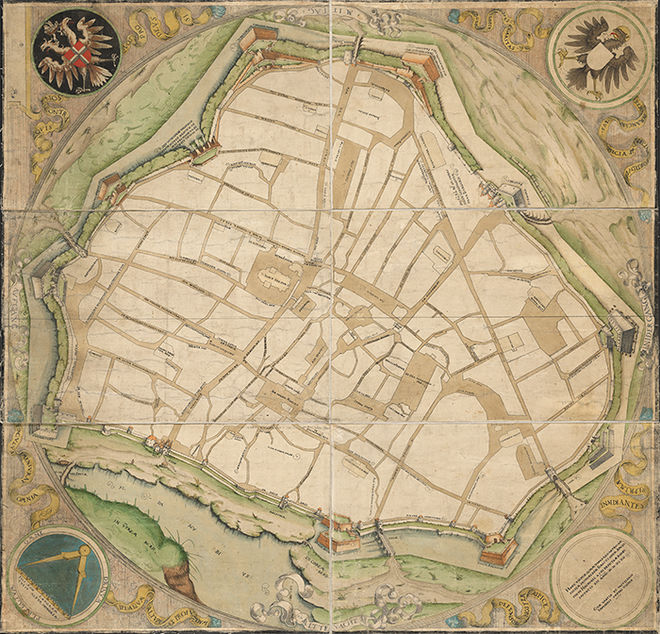
Augustin Hirschvogel, Map of Vienna, 1552. Etching with hand-coloring on laid paper, 81.9 x 85.4 cm. National Gallery of Art, Rosenwald Collection, 1954.12.71.
When two technologies converged in the first half of the sixteenth century—artillery warfare and monumental printmaking—a new genre was the result. The monumental siege print was an experiment in how to depict distance between enemies as the defining condition of war. In this talk, Carolyn Yerkes explores a series of enormous woodcuts created in the German-speaking lands of northern Europe during a period of constant war, political turmoil, and religious strife. An Early Modern World Lecture Carolyn Yerkes is associate professor of early modern architecture at Princeton University, where she chairs the Committee on Renaissance and Early Modern Studies. She has written books on Renaissance architectural drawings and on Piranesi; her articles range across a constellation of topics that include construction technology, staircases, the architecture of echoes, carpenters in the American Revolution, sculptures used as lethal weapons, and the first printed self-portrait. Her next book is called Siegelands: Early Modern Warfare and the Monumental Print. |
©2026 Bard Graduate Center
Bard Graduate Center Gallery
Monday: Closed
Tuesday: 11 am–5 pm
Wednesday: 11 am–6 pm
Thursday: 11 am–5 pm
Friday: 11 am–8 pm
Saturday–Sunday: 11 am–5 pm
18 West 86th St.
New York, NY 10024
212.501.3023
[email protected]
Follow



©2026 Bard Graduate Center