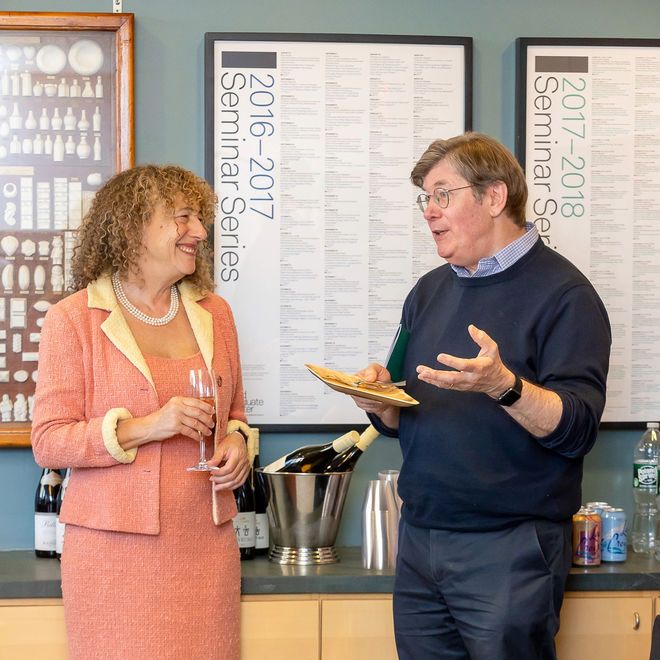
Our faculty continue to promote scholarship in decorative arts and design history, inspire our students and contribute to institutions, museums and publications worldwide. Here are select highlights from the past year.
Director and founder Susan Weber contributed chapters on British and American biscuit tins for BGC’s upcoming show Consuming Culture: British & American Biscuit Tins (Spring 2028). This exhibition, co-curated with Deborah Krohn, will be the first American exhibition on this topic in over forty years. Last fall, Weber, Krohn, and the exhibition team visited the world’s largest biscuit tin collections at the Victoria and Albert Museum, the Museum of Brands, the Museum of English Rural Life, and the Reading Museum. They explored Special Collections at the University of Reading, the largest collection of archival materials of well-known British biscuit companies such as Huntley & Palmers, Carr & Co, and Macfarlane, Lang & Co. Weber is also at work on research for Philip Webb for the upcoming Philip Webb: Truth in Beauty exhibition (Fall of 2027). She is also contributing her scholarship on the professional and personal relationship between British architects and designers, William Burges and E.W. Godwin to a Special Issue of 19: Interdisciplinary Studies in the Long Nineteenth Century (Fall 2027).
Caspar Meyer, Professor, Chair of Academic Programs (AY 2026-2027), and editor of West 86th: A Journal of Decorative Arts, Design History, and Material Culture, taught the new course, “Supple Solids: A Deep History of Soft Containers” last fall. In the spring, he taught revised versions of “Digital Archaeological Heritage”, with Meredith Linn, and “From Temples to Museums: Afterlives of Classical Statues” co-taught with Jeffrey Collins. Meyer and Linn also launched the 2026 Bard Travel Program to Barbados, developed through the Mellon Foundation, Constant and Carmichael Research Project and hosted by the University of the West Indies at Cave Hill. In May, Meyer traveled to Greece to continue experimental fieldwork on the artisanal firing of classical black gloss ceramics and presented a paper on bronze hammering techniques in the conference Rethinking Archaic Greek Sculpture at the Harvard Center for Hellenic Studies in Nafplio. Over the summer, Professor Meyer delivered keynote lectures at the conferences Making Matters: Processes and Meaning of Crafting in Graeco-Roman Antiquity (University of Zurich) and Materials, Materiality and Knowledge, part of the Locally Crafted Empires initiative at the Royal Danish Academy of Sciences and Letters in Copenhagen. Recently, he published, The Scythians Lost Civilizations (University of Chicago Press 2026), which reimagines the Scythians as highly mobile cultural innovators.
Jeffrey Collins, Professor, convened Objects in Context with twenty-five entering students last fall and led a seminar on “The Monument: Designing Memory.” In the spring, he oversaw MA and PhD admissions with Meredith Linn and co-led, the seminar “From Temples to Museums: Afterlives of Classical Statues,” with Caspar Meyer. Between September and December, he gave four lectures at the New York Society Library on the Baroque as an international aesthetic phenomenon, sponsored by the American Friends of Les Arts Florissants. In December, Professor Collins contributed a paper on “The Social Life of Statues” to the international conference “The Future of the Antique: Interpreting the Sculptural Canon,” held at the Institute of Classical Studies and Warburg Institute, University of London. Professor Collins’ review of Pamela Bianchi’s book The Origins of the Exhibition Space (1450-1750) appeared in the September 2025 issue of Journal of the Society of Architectural Historians, and his review of the Lewis Walpole Library’s exhibition Caricatures, Campagna, and Connoisseurs: Thomas Patch and the British Grand Tour in Eighteenth-Century Italy appeared in the December 2025 issue of the Burlington Magazine. In April, he contributed the chapter “Stone Cold: Scrambling for Statu(e)s in Eighteenth-Century Rome” to the volume Buying Art and Antiquities in Eighteenth-Century Italy (Brill 2026). In May, Professor Collins led the 2026 Bard Travel Program in Paris in partnership with the École du Louvre, focusing on glass, textiles, and fashion.
2026 marked Professor Aaron Glass’ final academic year as Associate Chair of Research Programs, overseeing BGC’s departments of Publications, Digital Humanities/Digital Exhibitions, and Public Humanities + Research. He taught “Exhibiting Culture(s): Anthropology in/of the Museum” (Fall 2025), and “Ethnography and the Material World” (Spring 2026). Glass continued editing the forthcoming Critical Edition of Franz Boas’s landmark 1897 monograph on Kwakwaka’wakw (Kwakiutl) culture, on which he published an essay, co-authored with Judith Berman, “Remediating the Boas/Hunt Archive: On Ethnographic Collections, Indigenous Ontologies, and the Problem of Metadata” (Museum History Journal 182: 1-21). He also lectured in the Northwest Coast Hall at the American Museum of Natural History, and consulted on loans for the 2026 exhibition, “Come Together: 3,000 Years of Stories and Storytelling,” at the Morgan Library and Museum.
Andrew Kircher, Lecturer, Director of Public Humanities + Research, is the dramaturg on FIVE YEARS, a multi-channel performance installation built from thousands of short clips by the interdisciplinary theater company 600 HIGHWAYMEN. FIVE YEARS, which premiered at PS21 in the summer, is showing at The Public in January. Over the last year, Andrew has organized the public programs lecture series, Weds@BGC, which coincided with Viollet-le-Duc: Drawing Worlds as well as the current exhibition, Goddesses in the Machine. For Viollet-le-Duc: Drawing Worlds, Andrew worked with Ubisoft, the team behind Assassin’s Creed, to show the animated reconstruction of the Notre-Dame Cathedral built from 5,000 hours of research, using virtual reality headsets. He currently advises and facilitates the researchers working in the 4N studio space in Goddesses in the Machine as they reconstruct one-hundred year old garments featured in the exhibit.
Deborah Krohn, Professor and Chair of Research Programs and editor-in-chief of West 86th: A Journal of Decorative Arts, Design History, and Material Culture, participated in an international workshop on historical gastronomy in October 2025 at Český Krumlov, Czech Republic, where she witnessed the recreation of a dessert service around a functional eighteenth-century “magic table.” Professor Krohn contributed the chapter titled “Nach Italienischer Manier: Commemorating Peace on Nuremberg’s Tables” for Celebrations at Court: Ephemeral Objects, Materials and Machinery in the Early Modern Period (Yale University Press and Aarhus University Press, 2026) about two banquets held in Nuremberg around 1650 to celebrate the Peace of Westphalia. These projects helped frame her fall class in culinary history, in which students studied decorative arts and texts used in the kitchens and on the tables of early modern Europeans. In fall 2025, Professor Krohn conducted research in the United Kingdom with co-curator Susan Weber for the exhibition and accompanying publication, Consuming Culture: British and American Biscuit Tins (Spring 2028). That November, she also traveled to Mexico City for the annual meeting of the Association of Research Institutes in Art History, on which she serves as Vice President. In spring 2026 she co-taught a new class with Jesse Merandy, Director of Digital Humanities/Exhibitions, on the history and role of digital technology in museum contexts, guiding students in developing digital interventions for the upcoming biscuit tins exhibition. This summer, Professor Krohn led a group of BGC students on the Bard Travel Program to Venice, which focused on the study of glass and textiles in museums and historic houses around the lagoon.
Meredith Linn, Associate Professor, served on the admissions committee with Jeffrey Collins and co-taught “Digital Archaeological Heritage” with Caspar Meyer in the spring. With Caspar, Linn organized BGC student and alumni participation in the Theoretical Archaeology Group (TAG) conference. Along with Caspar Meyer and Annissa Malvoisin, Professor Linn led students on the first Bard Travel Program to Barbados, in partnership with the University of the West Indies at Cave Hill. Professor Linn has continued her research on Seneca Village, including expansion of the Envisioning Seneca Village (ESV) digital project, co-authored with Gergely Baics, Leah Meisterlin and Myles Zhang. ESV was part of the celebration of the village’s 200th anniversary at Mother AME Zion Church in September 2025. BGC alumni Mya Bailey (MA ’25) joined the project to research the sounds of Seneca Village. Professor Linn is writing a book about Seneca Village with Nan Rothschild and Diana diZerega Wall, to be published by Columbia University Press. Her edited volume, Revealing Communities, is soon to be published by BGC. Over the last year, Professor Linn gave many talks about her Seneca Village work, including at TAG, the Annual Meeting of the Social Science History Association, the Annual Meeting of the American Irish Teachers’ Association, the Church of St. Mary the Virgin, the Harlem School of the Arts, St. John’s University, and Barnard College. She also gave talks about her book, Irish Fever (University of Tennessee Press, 2024), at Montclair State University and UC Berkeley.
Annissa Malvoisin, affiliated faculty, designed and taught a new course in 2025, “Transcultural Objects”, based jointly on current research and the Arts of Africa collection at the Brooklyn Museum. Students contributed significant object-based research to inform the upcoming Arts of Africa galleries at the Brooklyn Museum, co-curated by Malvoisin, and shaped by her doctoral thesis. Malvoisin also helped organize the Material Culture of Africa and the African Diaspora lecture led by Associate Professor Drew Thompson. Malvoisin delivered several public and conference lectures: first on a panel for the Robert Goldwater Roundtable on African Art History: Other Africas at New York University, Institute of Fine Arts, and then at the TRANSMAT | IN2PAST 2025 International Conference at Museu Municipal Santos Rocha in Figuera da Foz, Portugal, where she presented Intersectional Biographies using 1st millennium BCE Nubian ceramics as a material case study. She also presented a published chapter, “The Unwavering Divide: Collection and Display Practices of Ancient and Medieval African Collections” from Ancient Pasts for Modern Audiences Public Scholarship and the Mediterranean World (Routledge, 2025) at the Archaeological Institute of America in Philadelphia. Malvoisin also co-chaired a panel, “Interconnectivity and Exchange with Northeast Africa”, at the American Society of Overseas Research (ASOR) Annual Meeting in Boston, where she presented a paper titled “The Egyptian Water Lily in Chad” that explored new research on pottery-specific transcultural connections. Additionally, she participated in two important programs––Villa Albertine Museums Next Generation and Studio Museum Arts Leadership Praxis.
Jesse Merandy, Director of Digital Humanities/Exhibitions, co-taught the course “In Focus: Digital Technologies and Exhibition Experience” with Deborah Krohn, exploring the history of digital technology’s role in the museum, gallery, and cultural heritage spaces. Students used this background to develop their own interactive prototypes for the 2028 exhibition Consuming Culture: British and American Biscuit Tins from the Great Exhibition to the Second World War. In addition, with the help of Julie Fuller, Manager of Digital Humanities and Education, the DHDX department supported a range of digital projects in the classroom including collaborative and individual websites, virtual exhibition designs, and 3D printing and object modelling. Many of these projects were featured in this year’s DHDX Salon, the yearly retrospective of work produced by BGC students that illustrates the inventive and diverse ways digital technologies are being used in their research. Finally, Merandy was incredibly proud to have two students successfully complete Digital Qualifying Papers last year: Mérida Mehaffey’s A Partnership Ethic: Indigenous Artist-Led Collaborations in Museums and Gabby Valencia’s Remembering and Performing Mexico: A Transnational Exploration of Women’s Baile Folklórico Costumes Representing Chiapas, Jalisco and Veracruz. Meanwhile, in the gallery, DHDX also collaborated with the curatorial and design teams to create interactive online website companions for the Sèvres Extraordinaire! and Viollet-le-Duc: Drawing Worlds exhibitions, preserving exhibition content as accessible public resources.
Andrew Morrall, Professor and Director of Doctoral Studies, presented a paper last summer titled, “The Enigma of the Object and the Flight of Melancholy in Dürer’s Melancholia I” at a workshop of the ARC-funded Research Project: Dürer’s Material World, at Melbourne University. A research leave in fall 2025 allowed Professor Morrall to write a chapter for a forthcoming volume, Materiality and Embodied Emotions in Albrecht Dürer’s Nuremberg (University of Amsterdam Press, 2026). He presented a version of this to a BGC audience in April. At the March Renaissance Society of America Conference, in Boston, Professor Morrall co-organized three sessions with Mark Meadow and Vera Keller, around the theme of “Collecting, Techne and Governance in the Early, Modern World,” the third event in an on-going research project. Also in March, Professor Morrall presented his paper, “Intermedialities between Art and Nature in the Works of Bernard Palissy,” in Intermediality and Synagonism in Northern European Art 1400-1700, at the Center for Renaissance and Reformation Studies, Toronto University. Two other articles, “Wenzel Jamnitzer and the Geometries of Nature” (Nuncius), and “Ideas,” in Ashley West, Christina Anderson eds., A Cultural History of Collecting, Bloomsbury, were published this year. Last spring Professor Morrall taught two classes “Craft and Kunstkammer” and “Objects of Belief: Religion and the Arts of Northern Europe 1450-1600”.
Helen Polson, Associate Professor of Practice in Writing and Exhibition Interpretations Editor, taught “Writing Objects” in the spring semester, a required course which develops the knowledge of forms and proficiency in techniques required for effective graduate-level writing. Professor Polson helped students refine assignments, essays, object labels, digital projects, qualifying papers, dissertations, and craft grant applications, personal statements and cover letters for internships, fellowships, further graduate study, and full-time employment. This year, many ambitious master’s and doctoral students submitted successful proposals for graduate-student and professional conferences. In addition to teaching proposal-writing in her class, Professor Polson organized opportunities for students to workshop their presentations with groups of peers and faculty. Participants not only gave their fellow students excellent feedback on their work but strengthened their own understanding of how to craft effective, well-structured presentations. Students have received overwhelmingly positive feedback on their conference papers, some of which became (or will become) their Qualifying Papers or will be published in some form. Expanding on this model, she co-organized, with PhD student Josh Massey, a series of “inforums”: informal lunch hour talks in which PhD students meet to present and discuss upcoming conference talks and work in progress. Last year, Professor Polson also edited interpretive texts for the dizzyingly well reviewed BGC exhibition Viollet-le-Duc: Drawing Worlds, and the current, Goddesses in the Machine: Fashion in American Silent Film. Currently, Professor Polson plans to inaugurate a BGC book club, pairing scholarly and literary works.
Julia Siemon, Lecturer, Deputy Director and Chief Curator, taught her first class at BGC last fall, “Curatorial Thinking: from Object to Exhibition.” In September 2025, Siemon published, with Selena Anders, “Eighteenth-Century Architectural Examinations at the Accademia di San Luca: New Evidence for the Concorsi Clementini” in the Journal of the Society of Architectural Historians. The article investigates a group of largely unpublished drawings, reconstructing the fundamental expectations for architects-in-training at one of the most prestigious academies in Enlightenment Europe and assembling critical new material for the history of architectural pedagogy. In October 2025, Siemon’s brief essay on sixteenth-century Netherlandish silver appeared in A Renaissance Treasure: The Schroder Collection at the Holburne Museum (Paul Holberton Publishing Ltd, 2025). Last November, her catalogue of preparatory drawings by the influential Renaissance print designer Johannes Stradanus was published digitally by Cooper Hewitt, Smithsonian Design Museum. That same month she gave a lecture, “Stradanus: Word and Image” at a symposium organized to celebrate the culmination of a multifaceted research effort for which Siemon was awarded major funding by the Getty Paper Project in 2021. In the Summer 2026 issue of Master Drawings, Siemon published “Reading Stradanus: Newly Uncovered Drawings, Inscriptions, and a Network Revealed.”
Drew Thompson, Associate Professor, had the incredible opportunity to develop writing and curatorial projects over the last year, supported by a Metropolitan Museum of Art’s History of Art Fellowship and an Arts Writers Grant from the Andy Warhol Foundation. As a MET Fellow in the Department of Photography, Thompson researched the collection as it related to his ongoing book project provisionally titled Coloring Surveillance through Polaroids: The Poetics of Black Sociality and Solidarity. In addition, Professor Thompson organized and mounted a collection rotation in Photographs from the Permanent Collection in the Robert Wood Johnson, Jr. Gallery. Thompson attended Paris Photo, AIPAD, and the 61st International Art Exhibition of La Biennale di Venezia. He also served in spring 2026 as a visiting critic in Painting and Sculpture at Yale University’s School of Art. Over the summer, Professor Thompson finished editing and overseeing the publication of a catalogue raisonné for a major US art collection, and contributed an essay for JJJJJerome Ellis’s forthcoming artist monograph.
Catherine Whalen, Associate Professor, taught the seminar “Americana Redux: Materializing Multiculturalism in the Postwar United States,” leading up to the U.S. Semiquincentennial, which investigated how individuals and groups have deployed material culture to challenge, redefine, and expand constructs of citizenship and belonging in the United States of America. Professor Whalen’s book project, Americana Redux: Materializing Multiculturalism in Postwar New York, likewise addresses these themes, focusing on New York City as a crucible for the discussion, debate, and contestation of these very issues. Last fall Professor Whalen also co-led the foundation course “Approaches to the Object” with Professor Ivan Gaskell, and in spring 2025 she taught the seminars “American Collectors and Collections,” and “Craft and Design in the USA, 1945-Present.” The latter course examines the shifting boundaries between the terms art, craft, and design, and foregrounds key makers and scholars contributing to this discourse. Students participated in the redesign of the Bard Graduate Center Craft, Art, and Design Oral History Project, relaunched this year with the help of Jesse Merandy, Director of Digital Humanities/Digital Exhibitions. This online archive presents student interviews with craftspeople, artists and designers working in glass, ceramics, metal, stone, fiber, fashion, graphics, and architecture, as well as curators and museum professionals in these fields. Professor Whalen also served on committees for the Events Series; Community, Accessibility and Belonging; and The Mr. and Mrs. Raymond J. Horowitz Book Prize on the Material Culture of the Americas.
Ittai Weinryb, Professor, Editor of West 86th: A Journal of Decorative Arts, Design History, and Material Culture, worked on Weaving, the latest volume from the book series which he co-founded, Art/Work/. The series, published by Princeton University Press, is set to narrate a new history of art founded in the study of objects, materials, and technology. The Dumbarton Oaks Yemeni bronze horse conservation project, which began in March 2024, continues with the hope that Harvard University Press will publish the results. And Professor Weinryb’s new book, Art and Frontier: The black Sea in the Global Middle Ages is in production with Princeton University Press and will be published in August 2027.