Excerpt from Dish: 813 Colorful, Wonderful Dinner Plates by Shax Riegler, Robert Bean (photographer)

Although there had been a long-standing New England tradition to set aside a Thursday in late November or early December as a day of Thanksgiving (dating back to the Pilgrims’ first one held at Plymouth in 1621), Abraham Lincoln finally signed an act making it a national holiday in 1863 after decades of campaigning for it by women like Sarah Josepha Hale, an author and the editor of the influential nineteenth-century magazine Godey’s Lady’s Book. As Mrs. Hale argued in her 1835 book,Traits of American Life, celebrating a holiday during “the funeral-faced month of November” would decorate the dreary season with “a garland of joy, [so that] instead of associating the days of fog, like our English relations, with sadness and suicide, we hail them as the era of gladness and good living.” Such a feast required fine sets of dishes and English manufacturers rushed to provide their American cousins with elaborate transferware pieces festooned with the bounties of the season and plenty of plump turkeys.

Johnson Brothers’ Windsorware Native American, also known as the “Standing Turkey” pattern, was manufactured from the early 1950s to the early 1970s. Here, the mostly brown transfer-printed design was hand tinted with other colored enamels. Most turkey plates are usually part of what is known as a short set. Rather than having to acquire a separate full dinner service, the hostess is able to mix these special pieces in with her regular set on the holiday.

The backstamp for Johnson Brothers’ Windsorware Native American is a work of art in itself. Note the green hash marks, the in-house hand-tinting artist’s “signature,” used for quality control.


Johnson Brothers’ His Majesty was introduced in the early 1950s and stayed in production until 1984. It was reissued a few years ago, but the back marks are different and the pattern is no longer hand tinted.


The original backstamp for His Majesty, used on pieces manufactured from the 1950s through 1984.

In traditional blue and white, Spode’s Festival looks old but was actually produced in the 1990s, illustrating just how long turkey china has been popular.


These two Royal Staffordshire plates utilize a turkey drawn by Clarice Cliff, the ceramics designer best known for her Art Deco Bizarreware. The upper plate is a so-called “go-along” for the long popular Tonquin pattern, in which the usual center motif has been swapped with the turkey. The border around the second plate has no known name, but Pamela Burleigh-Konopka, an antiques dealer specializing in turkey china, calls it “Autumn Leaves.”


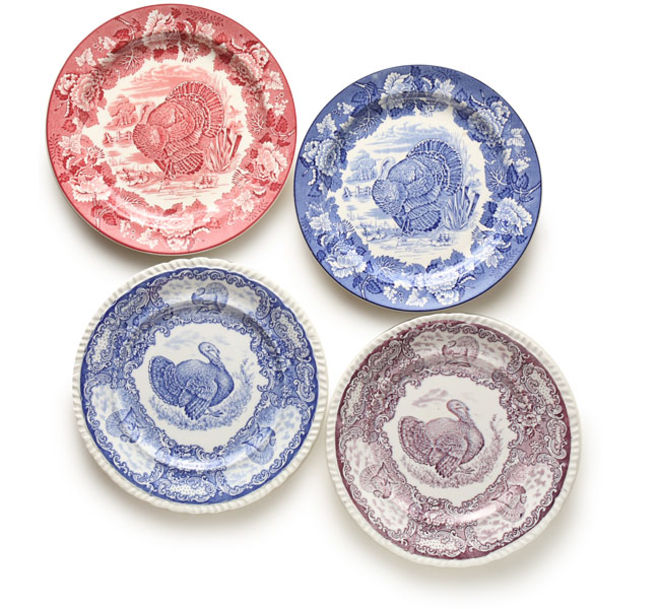
The top row shows a blue and a red example of Enoch Woods & Sons’ English Scenery, produced from 1917 until the early 1960s. For the American market the company created plates in which they replaced the usual pastoral scene in the center with this puffed up Tom Turkey. The second row shows two examples of a pattern imported from England by Rowland & Marsellus, a New York City retailer in business between 1893-1938.


Shax Riegler (MA 2007, MPhil 2009, PhD Candidate) is the executive editor at Architectural Digest. Prior to joining that magazine, he was the Content Lead for the Home & Appliances group at Consumer Reports. He has also served as executive editor of House Beautiful, and has held editorial positions at House & Garden, Martha Stewart Living, Travel & Leisure, and Vogue. His book, DISH: 813 Colorful, Wonderful Dinner Plates, was published by Artisan in 2011. He received his undergraduate degree from Kenyon College.