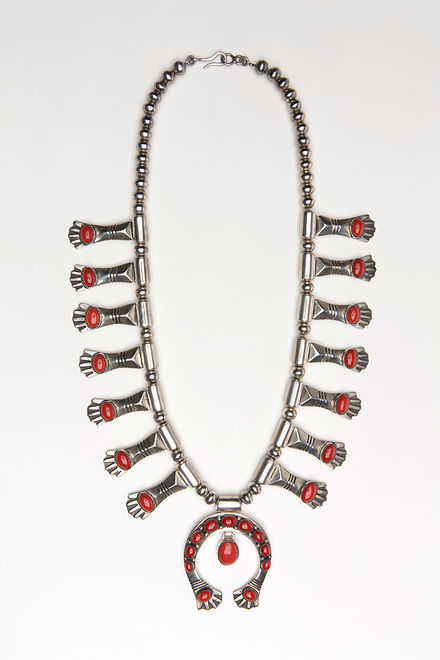
Julian Lovato (1925–2018, Santo Domingo Pueblo), silver and coral necklace, ca. 1970s. Wheelwright Museum Collection, Daniel E. Prall Fund and anonymous donor.
Native American jewelry has a capaciousness, allowing wider theoretical and museological trends to be understood, while also illuminating a granular articulation of lives, community aesthetics, and market forces. Addressing early anthropological enquiry, later craft scholarship, and more recent art historical writing, this lecture examines the conditions under which knowledge about Native American jewelry has been produced, and how those conditions have been reshaped through sustained acts of thinking and looking, and through conversations with makers.
An Indigenous Arts in Transition Lecture.
Henrietta Lidchi is a researcher and curator whose work focuses on art and material culture of Indigenous North America, critical historical work on European museums, and questions of representation and photography. Publications include The Poetics and Politics of Representing World (Other) Cultures (2025), Dividing the Spoils: Perspectives on Military Collections and the British Empire (2020), Surviving Desires: Making and Selling Jewellery in the American Southwest (2015), Visual Currencies: Reflections on Native Photography (2009), and Imaging the Arctic (1998). Lidchi has worked at the British Museum, National Museums Scotland, and the Wereldmuseum Amsterdam. Most recently, she served as the executive director of the Wheelwright Museum of the American Indian in Santa Fe. She has curated numerous exhibitions and participated in major international research initiatives, including projects at the Humboldt-Universität zu Berlin and the School of Social and Political Science at the University of Edinburgh. In 2017–22 she was involved in national policy development, serving on national committees in the Netherlands and Austria relating to colonial collecting and questions of return. In May Lidchi moved to Berlin to take up the role of director of the Ethnological Museum and the Museum of Asian Art in the Humboldt Forum.
Object Labs
At Bard Graduate Center, we use an object-centered approach to advance the study of the decorative arts, design history, and material culture. Join our student educators before select Fall 2026 public events to learn about some of the objects in BGC’s Study Collection. Each week we will showcase three objects carefully selected from the collection, which includes more than five thousand objects in a variety of media. Drop in anytime between 5 and 6 pm; the experience takes roughly ten minutes.
October 7, 14, and 21
November 4, 11, and 18
38 West 86th Street, New York
5–6 pm
Founded in 2011, the BGC Study Collection supports student research by providing opportunities for hands-on close examination of objects. Learn more about the BGC Study Collection here.