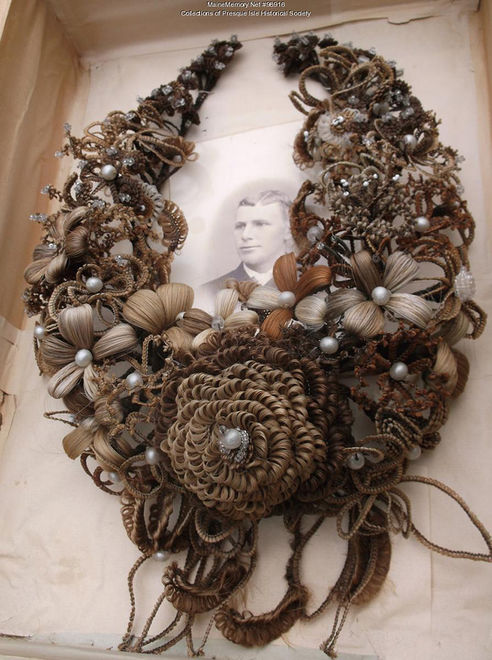
Hair wreath, Presque Isle, ca. 1860.
Nineteenth-century England was rife with sentimental culture. Death rates were high due to numerous factors including disease, war, and high childhood mortality. Queen Victoria became an unlikely fashion icon when she submerged herself in mourning after the deaths of both her husband, Prince Albert, and her mother in 1861. Aside from her mostly black wardrobe, she was widely known for her love of mourning jewelry, which contained the hair of loved ones inside. Victorian hairwork became popular in both jewelry and shadowbox form, transcending the concept of a wearable human relic into a fashion statement of the period. This lecture will explore this connection between fashion and mourning and will highlight several pieces from the largest collection of ornamental hairwork in America—Leila’s Hair Museum—of which many pieces are now housed at the Morbid Anatomy Library in Brooklyn.
Karen Bachmann teaches at both Pratt Institute and Fashion Institute of Technology. She specializes in both fine and bridge jewelry, wearable art, and decorative art. She has interests in baroque, renaissance, memento mori, and Victorian wearable ornament and material culture. She is a practicing studio jeweler and a former master jeweler at Tiffany & Co. She is a past and current lecturer and workshop leader with NYC Jewelry Week. Her current line of jewelry centers anatomically correct human organs and insects, which are carved in wax and cast into sterling silver or brass using the lost-wax casting technique, a subject that she teaches. Her studio work has been published in Art Jewelry Today and the Lark 500 series books. Written published work includes “Hairy Secrets: Human Relic as Memory Object in Victorian Hairwork Jewelry.” Her most recent publication is an essay on nineteenth-century mourning jewelry in the book Death: A Graveside Companion (2017). She has delivered lectures and organized workshops at the American Folk Art Museum, Mütter Museum, Victorian Society of America, Morbid Anatomy Museum, Atlas Obscura, Katonah Museum of Art, and the Viktor Wynd Museum of Curiosities, Fine Art, and Natural History.