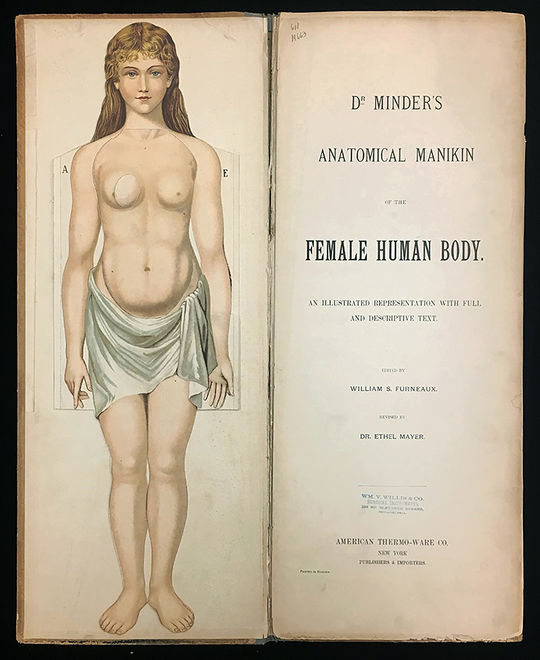
William Furneaux (ed.) and Ethel Mayer (rev.), Dr. Minder’s Anatomical Manikin of the Female Human Body: An Illustrated Representation with Full and Descriptive Text (New York: American Thermo-Ware Co., ca. 1905).
This talk explores the history of so-called flap anatomies, printed atlases of human anatomy that offer readers the opportunity to engage in a virtual dissection as they fold back layered paper models of the body. The earliest flap anatomies, developed in Germany in the sixteenth century, employed the technology of the printing press to create paper facsimiles of the human form. By the late nineteenth century, colorful flap anatomies printed using the process of chromolithography decorated the walls of physicians’ offices, the desks of medical students, and the bookshelves of middle-class families in Europe, the United States, and around the world. They offered popular audiences access to detailed and comprehensive knowledge on topics rarely discussed in the drawing room, from digestion to human reproduction. Such works not only affirmed the privileged status of anatomy as a visual and textual language for describing the body but also reinscribed older forms of knowledge, including the “secrets of women,” within the framework of modern medical science. By attending closely to materiality and sensory practices, this talk links the multisensorial aspects of flap anatomies to the medicalization of touch as well as to efforts to subvert the authority of mainstream medicine through embodied forms of learning and exploration.
Bard Graduate Center is grateful for the generous support of the Selz Foundation.
Jessica M. Dandona, PhD, is an art historian and professor in the liberal arts department at the Minneapolis College of Art and Design, where she teaches courses on art and empire, the body in art and visual culture, and modern art. Dr. Dandona has been the recipient of research grants from the Fulbright Association, the American Philosophical Society, the Huntington Library, the Staatsbibliothek zu Berlin, and other institutions. Recent publications include articles in the journals Bulletin of the History of Medicine and Mortality as well as chapters in the edited volumes Art & the Critical Medical Humanities (forthcoming 2026), Rethinking the Public Fetus: Historical Perspectives on the Visual Culture of Pregnancy (2024), and Making Sense of Medicine: Materiality and the Reproduction of Medical Knowledge (2022). Dr. Dandona’s current book project, The Transparent Woman: Medical Visualities in Fin-de-Siècle Europe and the United States, 1880–1900, examines the visual culture of medicine at the end of the nineteenth century.
Object Labs
At BGC, we use an object-centered approach to advance the study of the decorative arts, design history, and material culture. Join our student educators before select spring 2026 public events to learn about some of the objects in BGC’s Study Collection. Each week we will showcase three objects carefully selected from the collection, which includes more than 5,000 objects in a variety of media. Drop in anytime between 5 and 6pm; the experience takes roughly 10 minutes.
February 25; March 4 and 25; April 8, 15, and 22
38 West 86th Street, 5–6 pm
Founded in 2011, the BGC Study Collection supports student research by providing opportunities for hands-on close examination of objects. Learn more about the BGC Study Collection here.