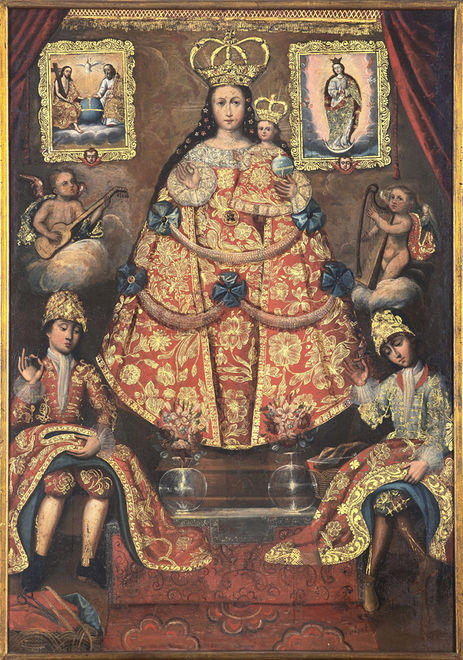
Textiles have been central to the material culture of the Andes since time immemorial. With the Spanish colonization of the Americas, the textile primacy of the Andes adapted: rather than a straightforward imposition of European trends, Indigenous fashion and textile practices have undergone complex processes of “cultural authentication” and “survivance.” This lecture unravels evidence from archival and pictorial sources from the sixteenth through the eighteenth century to recenter the Indigenous agents, materialities, techniques, technologies, and systems of knowledge that have shaped Indigenous fashion practices in the Andes. It thus offers a reevaluation of the history of fashion and textiles in the colonial Andes to demonstrate that Native American and Euro-American histories of fashion and textiles are inevitably intertwined, complex, and mutually influential.
Dr Laura Beltrán-Rubio is a researcher, curator, and educator, specializing in the history of art and fashion. Her research explores the construction and performance of identities through artistic expression, with a broad interest in Native American and Indigenous fashion and textiles. Her first book, Empire of Fashion: Luxury, Consumption and Identity in the Viceroyalty of New Granada, is under contract with the University of Texas Press. Beltrán-Rubio completed her PhD at the College of William and Mary (Williamsburg, VA) and holds an MA in Fashion Studies from Parsons School of Design (New York). She has previously taught at Parsons, William and Mary, Universidad de los Andes (Bogotá, Colombia), and De Montfort University (Leicester, UK). She is senior researcher and managing editor at the Fashion and Race Database and hosts the podcast Redressing Fashion. As a public-facing scholar, her mission is to expand the narratives of fashion to create more diverse, equitable, and socially just societies.
Object Labs
At BGC, we use an object-centered approach to advance the study of the decorative arts, design history, and material culture. Join our student educators before select spring 2026 public events to learn about some of the objects in BGC’s Study Collection. Each week we will showcase three objects carefully selected from the collection, which includes more than 5,000 objects in a variety of media. Drop in anytime between 5 and 6pm; the experience takes roughly 10 minutes.
February 25; March 4 and 25; April 8, 15, and 22
38 West 86th Street, 5–6 pm
Founded in 2011, the BGC Study Collection supports student research by providing opportunities for hands-on close examination of objects. Learn more about the BGC Study Collection here.
|
|