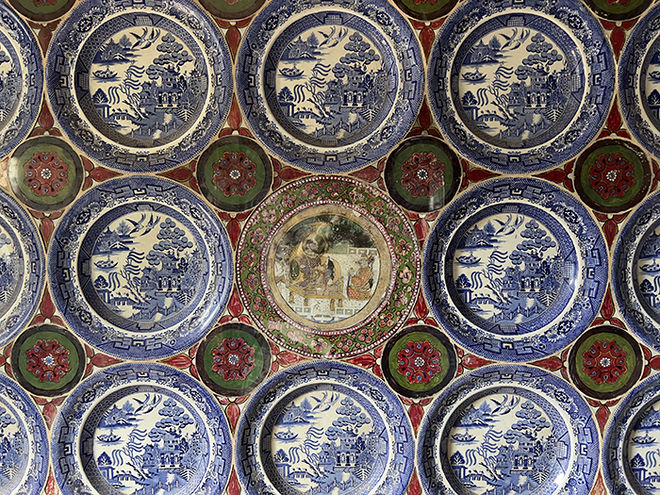
In nineteenth-century India, the popular Willow pattern transferware from Staffordshire found a new life as affixed ornamentations in palace interiors. Set into walls in original form, or broken into flat, rectilinear pieces to meticulously cover walls, niches, and balconies, Blue Willow plates and their luminous blue and white surfaces effectively framed gods and kings and created a multisensory experience of space. Taking two late nineteenth-century sites, Juna Mahal in Dungarpur and Junagadh Fort in Bikaner, as points of departure, Heeryoon Shin explores how the design and materiality of Willow ware, as well as its display, acquired new meaning and purpose in Indian palace spaces. Evoking the tradition of tiled ornamentation and the display of ceramics in the chini khana (“China room”) in India, while also referencing European porcelain rooms, the transferware-covered walls reveal the complex cultural negotiations and material and political aspirations of nineteenth-century India. By examining the Indian reuse of British transferware, this talk complicates the conventional narrative of West looking East and highlights the nonlinear and multidirectional flows of ceramic culture.
Heeryoon Shin is assistant professor of art history and visual culture at Bard College. Her current book project explores architectural revival, mobility, and cross-cultural exchange in eighteenth-century India through the lens of temple architecture in the pilgrimage city of Banaras. She is also developing a second project on the global circulation of blue and white ceramics and their interaction with local production and use in South Asia.
Object Labs
At BGC, we use an object-centered approach to advance the study of the decorative arts, design history, and material culture. Join our student educators before select spring 2026 public events to learn about some of the objects in BGC’s Study Collection. Each week we will showcase three objects carefully selected from the collection, which includes more than 5,000 objects in a variety of media. Drop in anytime between 5 and 6pm; the experience takes roughly 10 minutes.
February 25; March 4 and 25; April 8, 15, and 22
38 West 86th Street, 5–6 pm
Founded in 2011, the BGC Study Collection supports student research by providing opportunities for hands-on close examination of objects. Learn more about the BGC Study Collection here.