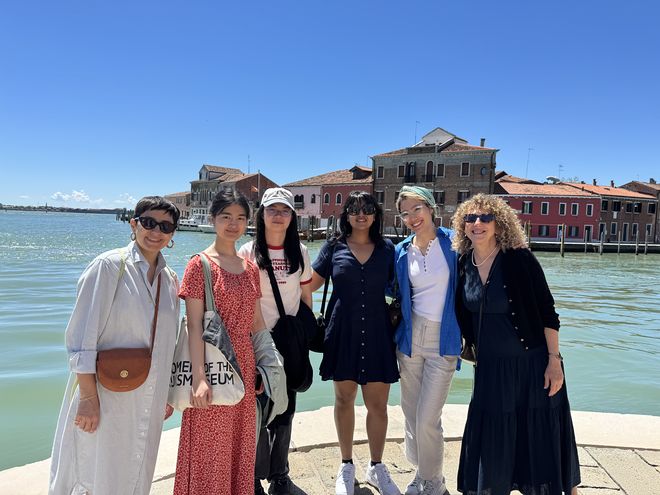
If the title of this essay sounds a bit random, that’s because Venice is a weird, wonderful, and magical place, where Gothic stained glass windows exist in perfect harmony with Renaissance panel paintings.
Eight first-year MA students, accompanied by Professors Deborah Krohn and Andrew Morrall, began our sojourn in the heart of Campo Santa Maria Formosa, the square where we gathered each morning to drink cappuccini and people-watch before setting off for the day’s first stop.
After a sacra conversazione, we admired how seamlessly Giovanni Bellini blended the architectural space of San Zaccaria with his altarpiece. Illusions of space like this would reappear throughout the trip, especially in buildings designed or inspired by the Venetian architect Andrea Palladio. Venice was such a whirlwind that just a couple of hours later we’d jumped forward to the twentieth and twenty-first centuries at Le Stanze del Vetro, where David Landau guided us through the galleries and archives, walking us through innovations in Italian glassmaking such as mezza filigrana.
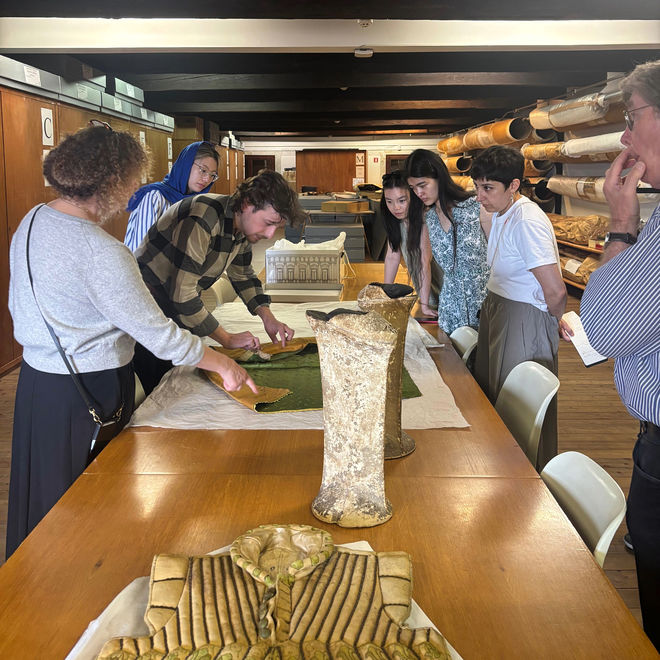
The next day we covered Basilica San Marco, Venice’s crown jewel—quite literally, given how many gems are embedded in the Pala d’Oro. We spent plenty of time with the famous altarpiece and the bronze horses, but what stood out most was a stone slab on the floor depicting a hedgehog, or riccio. Several passing tour guides each offered a different story for why the stone was there, so we made a point of confirming it: a pun on the name of Doge Francesco Erizzo (Erizzo, riccio—get it?) whose heart is buried beneath it. A quick tramezzino for lunch held us over for visits to Berengo Studio 1898, where we saw glass production at its finest, and to the Jewish Quarter, followed by aperitivo and some much-needed gelato.
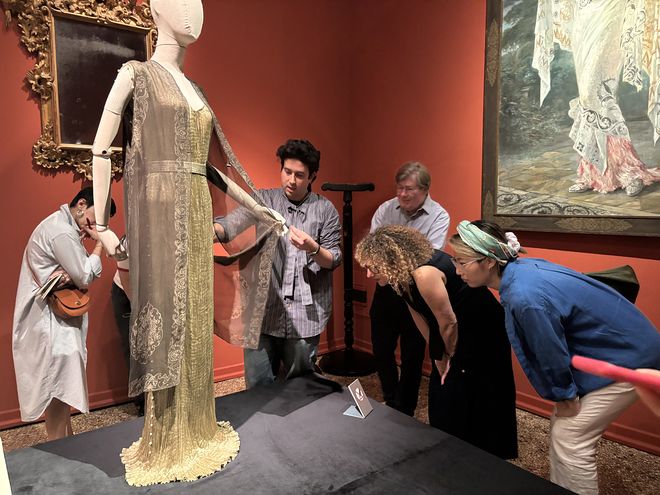
Next we learned about another side of glassmaking at Fornace Orsoni, Venice’s only active mosaic smalto tessera studio. Their color library seemed endless, and the idea of bringing some of their mosaics back to install at Bard Graduate Center felt irresistible. We spent several more hours in the galleries of the Museo del Vetro in Murano, marveling at miniature portraits rendered in glass. That evening we turned to textiles, examining hundreds of dresses, shoes, and coats with Luigi Zanini at the Museo di Palazzo Mocenigo.
Later, we learned firsthand how delicate and demanding textile production can be—first at Tessitura Bevilacqua, where a formidable group of women showed us how they weave extraordinary velvets on eighteenth-century looms, and then at the Museo del Merletto in Burano, where each of us learned the art of needlepoint lace from a nonna with three or four decades of experience. Somehow, after three hours and a thousand tiny stitches, something resembling a flower emerged.
Another afternoon was spent roaming the richly textured, layered interiors of the Museo Fortuny with our guide, the passionate Leonardo Manera. Fortuny, like many of his nineteenth-century peers, was an eclectic collector and a Renaissance man who filled his palazzo with arms and armor, velvets, and oil paintings. In many ways, the specialized workshops we’d visited all led here—to the culmination of their craft in Fortuny’s home.
The climax of the trip—fittingly, given the dramatic stage Andrea Palladio built for the Teatro Olimpico—took us outside Venice to Vicenza. Here, Bellini’s subtle linear perspective was pushed to its logical extreme: the stage appeared to stretch back far deeper than its actual, much shorter depth. We hiked up to Villa Valmarana and La Rotonda for sweeping views of the Veneto valleys and the scent of rose and lavender, carefully tended. Another theme of the day: a school of enormous fish in the river held our attention for quite a while, and later, a beautiful sea bass, caught fresh, starred at our celebratory dinner.
And then, just as we’d arrived by water taxi to the strains of Luchino Visconti’s Death in Venice, we sailed back out, each of us toward our next destination.