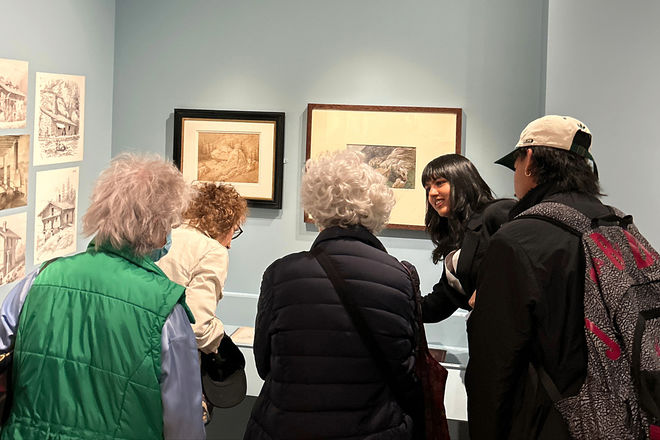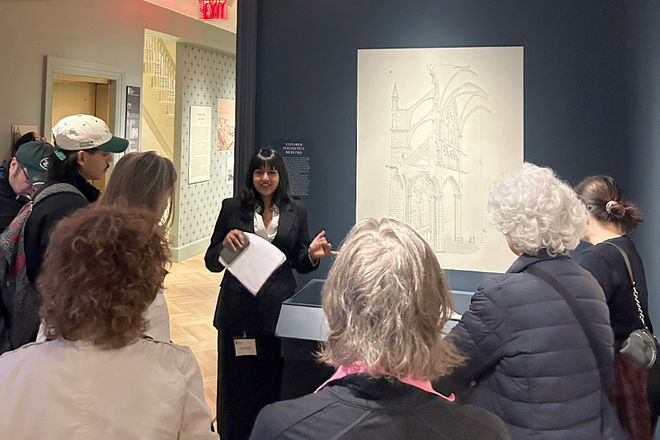
Viollet-le-Duc: Drawing Worlds, on view at the Bard Graduate Center Gallery from January 28–May 24, 2026, focused on the nineteenth-century French architect and restorer’s drawings, arguing that drawing was not merely a mechanical tool in the architect’s process but a vehicle for imagining and world-building.
As a Gallery Educator at BGC, I faced two challenges while developing my tour. First, how could I activate the drawings so visitors could see past their authoritative appearance and recognize how carefully the draftsman composed them, much as one would a photograph or painting? Second, how could I find my own way into the exhibition, one that connected to my research interests in Islamic art and architecture?
After spending weeks walking the galleries and sitting with the drawings following the opening, I found dangling threads on each floor that I could tie together into a single story: Viollet-le-Duc’s—and more broadly, nineteenth-century Europe’s—strained yet enchanted view of Islamic architecture. The research was intense. I dug through old syllabi, particularly from graduate seminars I’d taken on Islamic ornament and medieval architecture, and spent hours unpacking themes like Orientalism, Neo-Moorish design, and the Persian-Gothic thesis with fellow Gallery Educators and mentors Andrew Kircher (Director of Public Humanities and Research) and Mary Adeogun (Manager of Public Research and Education). Their patience and support helped me tackle intimidating architectural and engineering concepts—mass, gravity, force, load-bearing—and figure out how to teach visitors to spot these features in Viollet-le-Duc’s drawings.
The tour opened on the first floor with Viollet-le-Duc’s early drawing of the Cappella Palatina in Palermo. There, in Sicily, he formed a strong early impression of muqarnas, the stalactite-like honeycomb structures unique to Islamic architecture. Historians still debate whether muqarnas were purely decorative—meant to evoke awe at God’s creation—or structurally meaningful and load-bearing. Viollet-le-Duc found them maddeningly difficult to draw yet hypnotic in effect. His self-funded Grand Tour exposed him to the colorful, dazzling medieval monuments built by Muslims or inspired by Islamic architecture, which later shaped his theories of structural rationalism.
The architect’s obsession with the logic of Gothic construction—which he considered the most rational and heroic building tradition—was tinged with French nationalism. He went on to argue that “style is to the work of art what blood is to the human body,” an idea he explored through drawings of primitive buildings tied to specific races, and embodied by building his own Swiss chalet in the image of what he considered Aryan mountain dwellings. On the second floor, I wanted visitors to see that his racist leanings were inseparable from his technically masterful drawings. Our discussions of structural rationalism illuminated architectural dialectics like structure-ornament and bone-mask, setting up a final encounter with Islamic architecture.
The tour’s last stop returned to muqarnas—a geometric mask concealing structure, unlike Viollet-le-Duc’s “honest” Gothic masonry—through a close-looking exercise. It centered on an imagined victory monument for Napoleon, proposed for Algiers in a blended French-Arab aesthetic. Though never built, Viollet-le-Duc’s drawings capture the era’s Neo-Moorish revival style, in which pseudo-Arabic epigraphy, horseshoe arches, camels, and muqarnas were layered onto a French military tower.
Together, the four stops revealed that even though Viollet-le-Duc appreciated the complexity of muqarnas as a young man in Italy, he never took Islamic architecture seriously—dismissing it as a style of passive sensory delight rather than active problem-solving. Had he looked sideways instead of down, he might have discovered that his Gothic saints held no monopoly on pointed arches and lateral force distribution. With his draftsmanship and scholarly rigor, he could have pioneered an architectural discourse unlike anything else in the late nineteenth century.