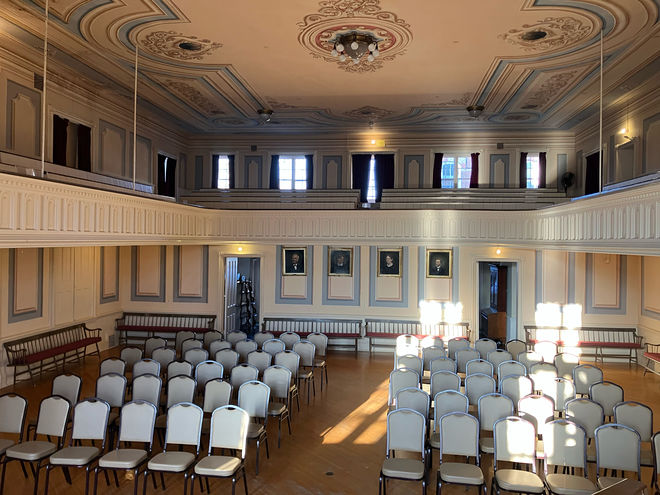
Main hall at Oneida Community Mansion House. Photo provided by Audrey Libatique.
It was the start of spring break when we made our way to the Oneida Mansion House, just outside of Syracuse. Two classmates and I had elected to make the pilgrimage upstate as part of an optional field trip offered through our spring course, In Search of the Good Place.
The course, a joint endeavor between Professors Hartzell and Morrall, traces utopian ideas from the early modern period to the present. At its core is a compelling premise: that design itself is a utopian project—an ongoing attempt to improve the material conditions that structure our world. Throughout the semester, we moved between speculative and realized visions of utopia, visiting places like the Museum of Arts and Design for Designing Motherhood and SCAPE, a landscape architecture firm that merges ecological systems with urban design. These excursions highlighted the gaps between imagined futures and lived environments, a central tension throughout the course.
The Oneida Community sits squarely at that intersection. Emerging in the early nineteenth century, Oneida was one of many experimental religious and social communities that flourished in the region of central and western New York. Shakers, Mormons, and Spiritualists all passed through this landscape, sometimes overlapping. As we learned from Tom Guiler, the director of the Oneida Museum, members of these communities were often in conversation, and occasionally in motion, as itinerant individuals switched between celibate Shaker villages and the radically opposed social structure at Oneida.
Home to around 300 members at its peak, the Mansion House today is part museum, part hotel, and part living community, as many descendants from the original Oneida community still keep apartments in the house. The community was founded in 1848 on what its leader, John Humphrey Noyes, termed “Bible communism,” a system in which property was held collectively and selfishness (what he called “stickiness”) was the greatest sin. These ideals extended into nearly every aspect of life, including labor, governance, and even intimate relationships. The community rejected monogamy in favor of “complex marriage,” where members were, in theory, married to one another collectively, with relationships mediated through structured social practices.
As Tom Guiler graciously guided us through the museum, answering even our most specific questions about sexual practice in the home, what struck me most was the realization that architecture here was not neutral. The design of the Mansion House actively shaped, and was shaped by, the community’s social experiment. Dormitory-style living, shared spaces, and circulation patterns all worked to reinforce the ideals of both collectivity and surveillance that defined Oneida’s daily life.
Staying overnight in the Mansion House also offered a rare chance to glimpse what life here might have been like after hours. Walking alone through the dimly lit halls, the sonorous clack of my wooden heels echoing against the floors, I imagined what it meant to sleep, live, and love within these walls.
At the start of the spring semester, we were asked to bring in an object we considered “utopian.” At somewhat of a loss, I pointed to a sticker long-stuck on my water bottle. Acquired during my undergraduate years at Oberlin College, it depicts a frazzled cartoon figure scrubbing dishes beneath the slogan, “Co-ops are good. Co-ops are fun.” It felt, at the time, like a slightly embarrassing choice. But standing in Oneida, I found myself returning to that object. My experience living in cooperative housing—sharing labor, participating in consensus-based decision-making—was the closest I had come to a lived experiment in utopianism. It was messy, and frequently frustrating, but also, as I realize now, a space where utopian ideals pressed most insistently against reality.
Leaving the Oneida Mansion, buzzing with new information, I found myself musing, almost plaintively, about just how long humans have sought to improve the ways they live together and provide for one another.
The Oneida Community disbanded in 1880, giving way to the “industry” period of the Mansion’s history, when operations shifted to silverware production under Oneida Community, Ltd. Dissolving under internal divisions and external pressure—particularly around some of the community’s more troubling approaches to reproduction and intimacy—the utopian vision at its core could not hold. Yet, like so many radical experiments in living, its complicated aftermath left material traces: physical structures, practices, and radical propositions that may still shape how we imagine living in new, and perhaps better, ways.