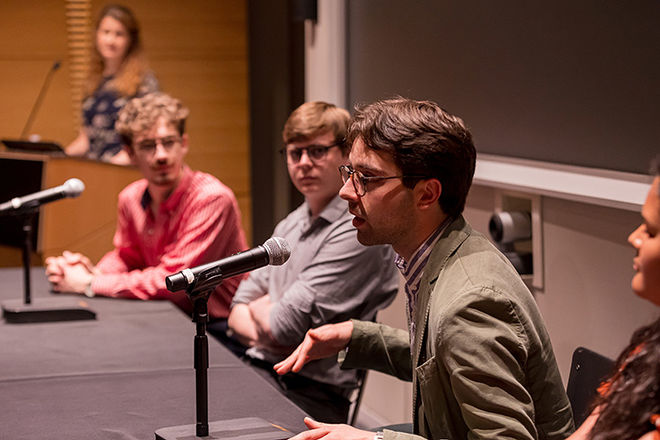
Photo by Fresco Arts Team.
The forming of the five senses is a labour of the entire history of the world down to the present.
— Karl Marx, Economic and Philosophic Manuscripts (1844)
Lose your mind and come to your senses.
— Frederich (Fritz) Perls, Gestalt Therapy Verbatim (1969)
This spring, Bard Graduate Center students will host its first Graduate Student Symposium in many years. “Sensing Matters: Bodies, Experiences, and Objects,” will explore how material things become animated through sensory engagement and how attention to the sensorium alters our understanding of them. The aim is to cultivate new lines of inquiry, provoke unexpected connections, and expand object-focused scholarship within BGC and the broader New York City graduate community.
Students planning the symposium hope to attract New York City-based graduate students at any level. They note that, “BGC prides itself on supporting interdisciplinary research and welcomes submissions from graduate students in diverse fields, including, but not limited to, anthropology, archaeology, art history, fashion studies, feminist studies, media studies, and postcolonial studies.”
According to the call for papers, “Objects engage with body and mind through sight, smell, touch, hearing, taste, proprioception, and other sensory dimensions. Studying objects only through detached observation—visually or within a single static context—limits our perception of their meanings and histories. We invite papers that challenge perceptions of objects as static or inert by closely investigating their relationships with human senses and the body. How might this sensory focus change the ways we approach the study of things? What are the political implications of considering the material agency of objects? How does bodily interaction between people and the objects that surround them contextualize lived experiences?”
Topics the symposium may explore include Culture and Cognition: How does an expanded approach to material culture studies destabilize the long-standing hierarchies that privilege certain senses and the frameworks through which they are constructed?
- Classifications: How does sensory and/or social perception challenge taxonomic terms like “objects,” “belongings,” or “things?”
- Ephemera/Change: How might an object’s material characteristics and sensory affordances generate novel or alternative uses and meanings across cultures?
- Living Matter: How do understandings of objects as living or nonliving beings speak to broader histories of colonialism, resistance, and the sacred?
- Breathing Deeply: How do scented objects mediate our perception of health, safety, and protection?
- Ergonomics and Accessibility: How has the shape of the body and the concept of comfort intersected with the design of objects and their use?
- Reconstruction: What experimental approaches to the study of things can we employ to resurrect sensorial experiences?
- Memory Formation: How can objects, through their sensory qualities, play an active role in collective memory creation?
- Sound and Space: How can the sounds produced by objects, such as the “scroop” of rusting silk, illuminate how they operated, signified, and mediated relationships within their social environments?