Media coverage of Viollet-le-Duc Drawing Worlds, the first major US exhibition devoted to the nineteenth-century architect and polymath who “restored Notre-Dame (the first time),”1 has been uniformly excellent.
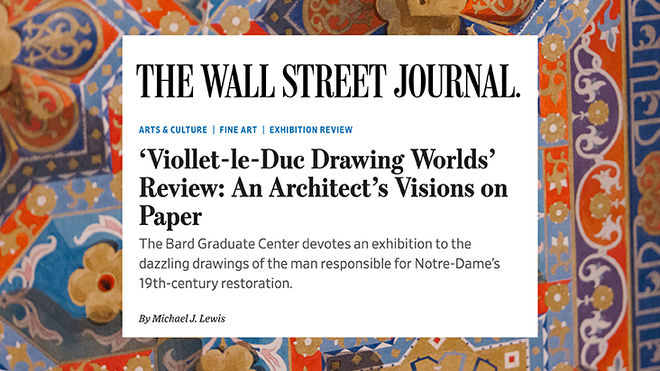
Michael J. Lewis, chief architecture critic for the Wall Street Journal, opened his review by asking, “Who expected that Notre-Dame Cathedral would emerge from the debris and lift its spire once more over the roofs of Paris, just five years after the fire of 2019?” Then noting, “That it could do so is due in no small part to Eugène Emmanuel Viollet-le-Duc (1814–1879), the architect … whose extraordinary drawings helped guide its new restoration.” Lewis wrote that the exhibition contains “an embarrassment of riches,” despite focusing on just one aspect of the architect’s career, “his complex relationship to drawing itself.” He continued, the drawings “are exceptionally lovely; even the driest … exult in line and color,” and further described them as “breathtaking” and “superb.” In the final lines of the review, Lewis concluded, “We leave the show realizing that Viollet-le-Duc was one of the world’s great pictorial thinkers, whose graphic curiosity recognized no boundaries between geology, anatomy and architecture. Leonardo da Vinci would have recognized a kindred spirit.”
Anatoly Grablevsky, the thirteenth and current Hilton Kramer Fellow at The New Criterion, wrote that Viollet-le-Duc’s drawings “bear witness to the workings of the architect’s extraordinary imagination, which combined medieval elements with delightful Romantic flights of fancy to create a revitalized neo-Gothic style fit for an emperor,” and reflected that Notre-Dame de Paris, Carcassonne, and Vézelay Abbey all owe him their fame, for he “comprehensively restored and reimagined these—and countless others—Romanesque and Gothic jewels. His works and writings placed medieval architecture at the core of French identity and influenced generations of pioneering architects, designers, and theorists, from Le Corbusier to William Morris.”
The Art Newspaper’s J. S. Marcus explained that Viollet-le-Duc’s restoration of Notre-Dame de Paris included a new, taller, and more distinctive spire that was “the Frenchman’s meditation on an idealised past rather than a recreation of what had once been. This dynamic approach to historic preservation—and, indeed, to history itself—is what so inspired [Frank Lloyd] Wright and others.” In Architectural Record, Patrick Templeton agreed that the 1858 wood model of the Viollet-le-Duc–designed spire “steals the show.”
In Tim Smith-Laing’s beautifully written and illustrated article in Apollo magazine, he also expressed admiration for the details of Viollet-le-Duc’s restoration of Notre-Dame de Paris: “Among his most beautiful drawings are the sheets of designs for the gargoyles he returned to Notre-Dame: hundreds of them, every single one given an individual physiognomy.”
Smith-Laing delved deeper into the exhibition’s riches, and found that “the selections in Drawing Worlds show [Viollet-le-Duc’s] attention to both the drama of life within buildings and the technicalities of their creation: a celebration of mass pierced by a sunbeam in the Palatine Chapel in Palermo; elevations of Santa Maria del Fiore in Florence and the Doge’s Palace in Venice; the minutiae of ceiling decorations in Messina.” He exclaimed that Viollet-le-Duc’s “many and varied talents were awe-inspiring” and that “he appears less as an architect than an incarnation of nineteenth-century France in all its equivocal magnificence.”
See Viollet-le-Duc Drawing Worlds before it closes on May 24.