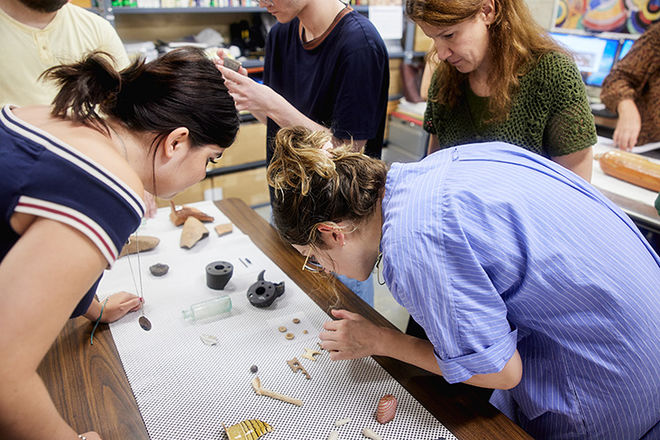
Photo by Brayden Heath Photography.
This spring, BGC students, alumni, and faculty are playing an essential role in the North American Theoretical Archaeology Group’s upcoming conference, TAG 2026, with the theme #RESIST. TAG is an organization founded in the UK in 1979 to discuss theory in archaeology; its main activity is a yearly conference. This year’s meeting of the American branch of TAG (founded in 2008) will be a three-day series of sessions for scholars, students, and makers to engage in interdisciplinary archaeological topics in a scholarly activist framework. One of its primary goals is to make space for conceptual advances in the field, and the BGC community is helping to do just that. Dr. Matthew Reilly, associate professor of anthropology and interdisciplinary programs at the City College of New York and co-subfield coordinator for archaeology at the CUNY Graduate Center, is currently a visiting fellow at BGC and one of the event’s key organizers. BGC faculty members Dr. Caspar Meyer, professor of classical archaeology and material culture, and Dr. Meredith Linn, associate professor of archaeology and the history of archaeology, serve on the organizing advisory board.
The conference is a wonderful example of collaboration among current BGC students and alumni that sometimes continues even after graduation. Seven of this year’s sessions are headed and organized by BGC scholars, such as “Coming to Our Senses: Interpreting the Multisensory Experiences of Past People” organized by Mya Rose Bailey (MA ’25), Allison Donoghue (MA ’24), and current MA student Brenna Gomez; “‘CTRL + Z’ : Resisting Permanence through the Digital” organized by Talia Perry (MA ’23) and Elana Neher (MA ’25); “Disappearing Acts: Presence and Absence in the Archaeological Record” organized by William Dunsmore (MA ’24) and PhD candidate Tova Kadish; “Material Resistances, Resistant Materials” organized by Julia Carabatsos (MA ’22) and current MA student Maria-Nefeli Panetsos; “Recalcitrant Things: Material Culture Perspectives on Discard and Reuse” organized by PhD candidate Joshua Massey (MA ’23); and “Resisting Master Narratives in Museums” organized by PhD candidate David Gassett and Leonie Treier (PhD ’25).
Second-year MA student Brenna Gomez, who is organizing the session “Coming to Our Senses: Interpreting the Multisensory Experiences of Past People,” described her journey to TAG through her professors: “Meredith Linn and Caspar Meyer first introduced me to TAG back in November and highlighted the experimental, innovative, and multimodal thinking the conference promotes. TAG is unique in prioritizing student participation in multiple aspects of conference planning and creating opportunities to bridge connections between current students, alumni, professors, and professionals.” On finding the topic of her session, she explained that “[t]he decision to propose a session on sensory archaeology with Mya Rose Bailey (MA ‘25) and Allison Donoghue (MA ‘24) came easily. I love their individual research into sensory experiences, and I knew that together we could organize a diverse session for TAG that challenges the way we conceptualize past experiences and peoples.”
According to Meyer, “TAG has long been a space for bold and critical thinking in archaeology. Hosting the event in New York City this year is especially exciting: it brings together scholars, students, and interdisciplinary thinkers to explore how archaeological research can engage with questions that really matter in the present context.” Linn added, “We are thrilled that so many of our current and former students have come together to organize sessions and that they will be sharing their innovative work at this important conference.”