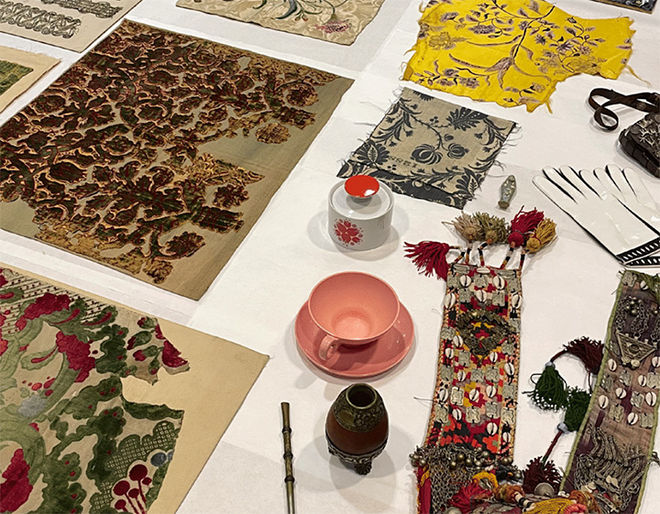
A selection of objects from BGC’s Study Collection displayed for a BGC alumni event. Staff photo.
Bard Graduate Center’s Study Collection was established with a simple phone call in 2011. Arnold Lehman, then director of the Brooklyn Museum, rang Susan Weber, BGC’s director and founder, to ask if she would like a donation of some items the museum was deaccessioning. Lehman, a BGC trustee, suspected that students would benefit from the opportunity for closer examination of objects than research visits to museums and archives would typically allow. He was right.
Since then, the Study Collection has grown to more than 5,000 objects in a variety of media including artifacts of glass, metal, ceramic, wood, plastic, textiles, paper, and more. Although many pieces come from Europe and North America and date from the eighteenth century to the present, there are significant holdings from Asia and Central and South America, as well as a growing number of objects from Africa. The collection’s strengths include modern ceramics, Indian and Southeast Asian textiles, silver, silver-plated flatware, jewelry, toys, costume accessories, and more than a thousand French and European textile samples dating from as early as the fifteenth century. Overall, the collection ranges from ancient objects to examples of industrial design and studio craft.
According to Weber, the collection’s potential has grown over the years. “From the beginning,” she said, “the Study Collection has afforded our students the rare opportunity to spend as much time as they wanted with objects of different time periods, materials, and cultures without someone hovering in the background or managing their experience. During Covid, it became a struggle for students to get research appointments in museums, and it is a challenge that continues to this day. I saw that a larger collection, guided to some degree by students’ own research interests, could help offset that difficulty.”
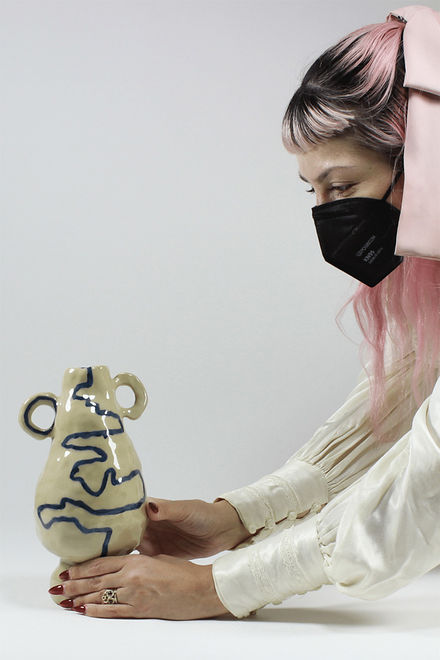
PhD candidate Elena Kanagy-Loux photographing a c. 2023 glazed stoneware pot belly vessel made
by Hannah Massey for Han Ceramics (Gift of Susan Weber).
Professor and Chair of Academic Programs Deborah Krohn was involved in the development of the Study Collection from its inception, going with Weber to the Brooklyn Museum to select the items from which it would grow. “We [the faculty] didn’t quite know how we would use it at first,” she said.
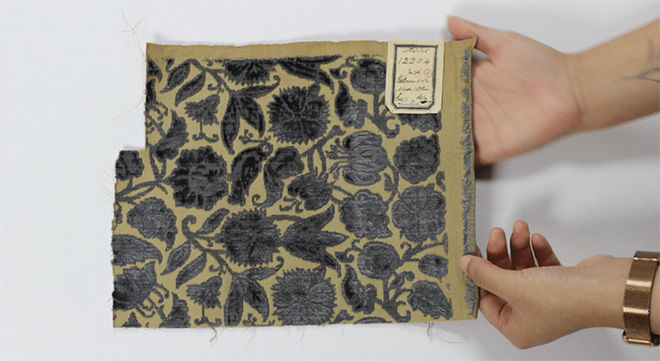
Cut pile silk velvet fragment from Parisian department store upholstery book, c. late 19th–early
20th century. Bard Graduate Center Study Collection, Ornella’s gift of anonymous hands.
However, that quickly changed. Krohn famously uses a shovel that was one of the founding items from the Brooklyn Museum each time she teaches Approaches to the Object, a course all BGC students are required to take. Although the element of surprise is important enough to Krohn that she did not want to reveal precisely how she uses it, she said, “It is a multivalent object. It’s mysterious. It’s in a material that you don’t usually associate with a tool. That makes it a great object for asking questions and exploring the relationship between function and history.”
This is exactly the kind of exploration that Krohn expects BGC students to perform. “Because the objects in the Study Collection are onsite and under our care, students can literally start their questioning with the object,” she explained. “As much as possible, I want them to approach these objects as if they are starting from zero, to forget that they already know they are looking at a mid-century modern ashtray or an aluminum coffee pot, and ask, ‘Why did someone make this? What does it do? Why is it broken or worn here?’”
The Study Collection is managed by Barb Elam, who notes that “This fall, it is slated to be more active than in any prior semester.” Student educators working in Public Humanities + Research will use objects from the Study Collection in their public Object Lab presentations, and professors leading courses including Approaches to the Object, Supple Solids: A Deep History of Soft Containers, Dress in Art History: A Field Seminar, and Curatorial Thinking: From Object to Exhibition have planned sessions that will, according to Elam, “engage students with Study Collection objects through examination, close looking, and touch.”
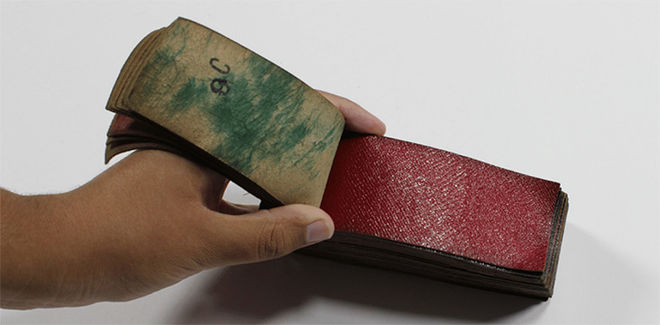
George & Co. Leatherwork Sample Book, c. 1926–1929. Leather. BGC Study Collection, Gift of
Martin and Patricia Levy.
Julia Siemon, Director of Exhibitions and Chief Curator at BGC, will teach Curatorial Thinking, and she plans to make extensive use of the Study Collection in her course. Students will spend time with a different group of objects in each class session, learning how to approach the works from a curatorial point of view.
The donors to the Study Collection are often as fascinating as the objects they give. Stephen Blank is one such donor. Recognized for his expertise in Canadian and North American economic integration, corporate strategy, and trade corridors and freight transportation, Blank has taught at Harvard, Yale, Dartmouth, Columbia, University of Pittsburgh, and Pace, and his career includes stints at the Ford Foundation, Council on Foreign Relations, and the Conference Board, as well as a long affiliation with the Fulbright Scholars program. Along with his late wife, Lenore, he has donated more than 100 objects to BGC’s Study Collection.
Many of their gifts reflect their travels and interests: Lenore’s collection of nineteenth- and twentieth-century rouge pots, Stephen’s passion for eighteenth- and nineteenth-century British pottery, their mutual interest in the work of traditional Canadian wood carvers. A nineteenth-century British transferware platter donated by the Blanks has become one of the most popular objects in the Study Collection, thanks to careful repair to the back of the dish. Professor Krohn remarked that the repair, done with large staples, “makes a deep impression on people, because it looks like stitches on a person’s body or old-fashioned surgery, alluding to both resilience and fragility.”
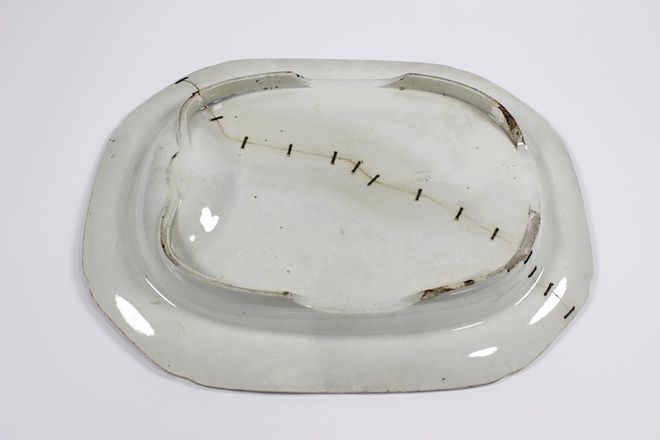
John Rogers & Son, Repaired Transferware Platter in "Camel" Pattern back, showing repair, 1843. BGC Study Collection, Gift of Lenore and Stephen Blank.
The platter was on display in the Blanks’ home in 2017 when a dinner guest remarked that BGC was interested in mended artwork. “And that,” Blank said, “is how it all began.” He recalled speaking to BGC students about the platter, and telling them that in his view, the repair “demonstrated that labor was much less expensive than capital.” A student argued that its owner must have really loved the dish to make such a repair. It led to a lively discussion among the students that, Blank said, “Barb [Elam] picked up on. When she saw the objects I was prepared to donate, she sent a team over to my place. When they left, I had to shake them off, but I loved the fact that they had so much expertise and took so much joy in looking at our collection. It suited our purposes, because with every object we collected, the assumption was that we were babysitting and then we would find a better home for it. We felt that was part of our responsibility.”
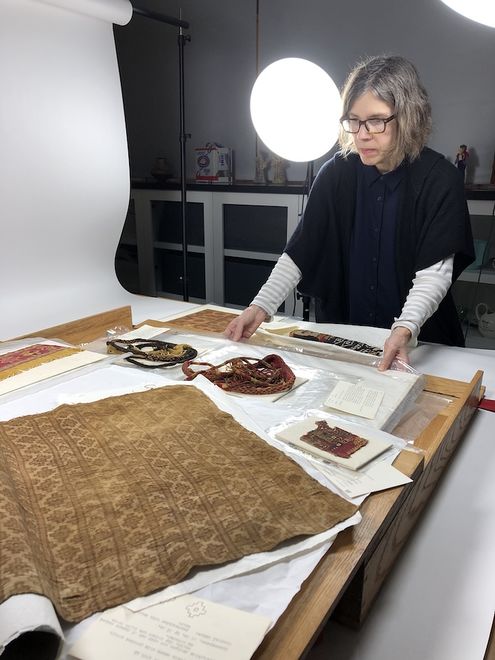
BGC Study Collection Manager Barb Elam prepares Study Collection objects for photography. Staff photo.
Recently Elam mounted a display of objects donated by the Blanks in BGC’s modest object lab exhibition area. Faculty, staff, and students dream of sufficient space for students to curate small exhibitions from Study Collection objects.
Emma Cormack, an alumna of BGC’s MA program and curator of the Study Collection, said she chose to attend BGC, in part, because she knew that she would have unfiltered access to the Study Collection. “Nothing compares to being able to handle objects and really understand what they are made of and how they were made and used. When you aren’t allowed to handle them, you can use a loupe, and you can look closely, but being able to feel the differences between materials and weave structures, for example, between your fingers is something you can’t do otherwise. So on top of the really robust pedagogical approach that students get at BGC, the Study Collection is a wonderful enhancement.”