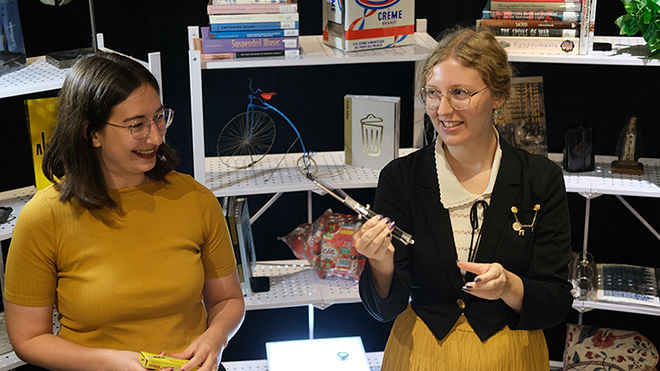
BGC students Olivia Kormos and Abigail Kosnick present their Object Lab. Photo by Du Zhou (MA ’26).
By Abigail Kosnik
What does a team of people passionate about public humanities do when they lose their main audience?This is the question that Bard Graduate Center’s Department of Public Humanities + Research faced at the end of 2024, when it became clear that exhibition programming would resume the following fall. I was hired as one of eleven gallery educators to lead tours through our fall 2024 exhibition, Sèvres Extraordinaire! Sculpture from 1740 Until Today. Thanks to the creativity of Andrew Kircher, director of Public Humanities + Research, and mary adeogun, manager of public research and education, we quickly pivoted toward strengthening our relationship with BGC’s other main public: the audience for the events series, Wednesdays@BGC. Through educator hours, we engaged our guests in conversation, answered questions, and generally did all we could to make the public feel welcome.
Our largest success this semester came from the Object Labs that accompanied the final months of public programming. Given only the presenter’s name and a brief description of their lecture, we were let loose into BGC’s Study Collection to pick objects tangentially related to the event, and encouraged to build connections and thematic congruences from there. This unique engagement with our Study Collection gave me a richer understanding of the breadth and scope of the objects that it contains. Our topics varied widely—from dolls that tackle complex stereotypes of the female body; to photographic memorabilia that capture a sense of intimacy with global events; to how geometry influences different mediums, be they woven velvet, ceramics, or glass. We workshopped each of these Object Labs with our peers in a collaborative and friendly environment, allowing us to play with how we connected objects and presented them to the public. Guests, too, added their knowledge and experiences to the narrative, sometimes recalling a similar item from their youths or providing a key detail they picked up from years of collecting experience.
My own Object Lab, which I co-created with my colleague Madeline Fuentes, focused on innovations in glass technology in the twentieth century. I had never imagined that glass could be so exciting! After hours of searching through the collections database, we decided upon three pieces: a stereoscopic viewer from 1904, a Pyrex tea kettle, and a milk glass souvenir vinegar bottle from the 1939 World’s Fair. We quickly realized that there was a strong connection of innovation between all of them, and the larger picture of a rapidly changing and industrialized twentieth century began to come into focus. While Julie Bellemare’s lecture, “Realgar Glass: Learning from the Archive, the Lab, and the Hot Shop,” was on a different type of glass, we were still able to challenge audiences to think of how everyday objects are evidence of incredible technological discoveries, and to illustrate that glass, as one of the oldest artforms, has always been a part of human innovation.
The Object Labs helped reinvigorate the Public Humanities + Research team after the exhibition delay, and also reminded us that engaging with the public can and should include all aspects of the institution. Through only five Object Labs in the last month of the spring season, my colleagues and I built a special rapport with our audience. I’m excited to see what creative new ideas our team comes up with to strengthen this bond and draw new guests in the year to come.
Founded in 2011, the BGC Study Collection supports student research by providing opportunities for hands-on close examination of objects. Learn more about the BGC Study Collection.